
Points of Entry
an inquiry

A note
Lately, every time I read something new I appreciate the truth that knowledge comes at an opportunity cost of more knowledge because it is a reminder of how much I don’t know.
I am aware of my insufficient knowledge concerning the political social and religious crossroads that have influenced so much of our shared collective identity today. The history I (and most of us) read growing up was that of convenience and my neglect of it post-academics evolved into ignorance over time. That is a dangerous position to be in because, when you know little of a particular subject matter, it is easy to get swayed by eloquent opinions of others which may or may not necessarily be accurate.
Which I why I read this book with a grain of salt. What particularly assuaged my apprehensions were the solid historical references and facts that served as foundations of a larger point. In this book, Nadeem Farooq Paracha, has made some very well structured and supported arguments. In most cases, he has left the exercise of opinion-making up to the reader. And lastly, he has attempted to unveil centuries of archaeological and cultural history most of us have never looked at.
These are some of the many reasons I would recommend this book to be read by everyone.
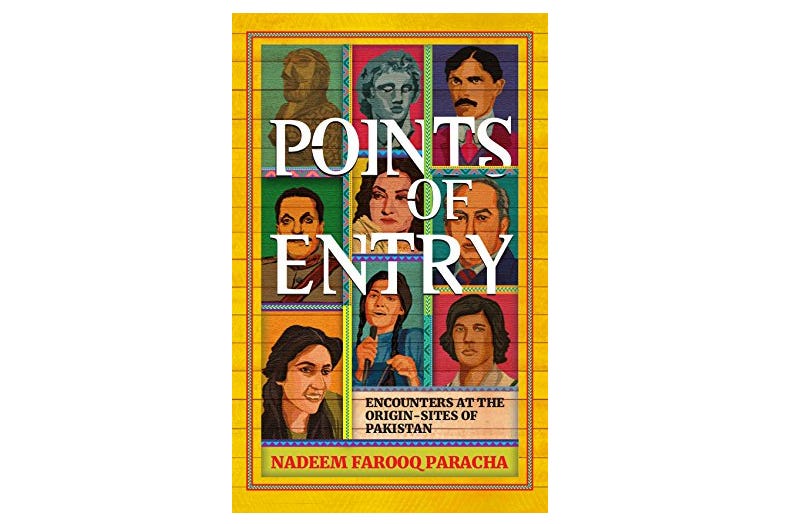
What does it really mean to be Pakistani?
In a collection of personal stories, journeys, and essays, Nadeem Farooq Paracha (NFP here-on for brevity) tries to pin down the major cultural influences, historical legacies, and political movements that have originated, percolated and continued to define the human identity of the land of Indus. His work is a journey into our past, an inquiry of the present, and a foreshadowing of the future. In the stories, NFP subtly touches multiple levels and layers that make up Pakistan - that are otherwise never heard of in media.
The first chapter goes all the way back. Mohen-jo-daro, one of the earliest cities of the Indus Valley Civilization, that is purported to have been the roots of modern-day South Asian Civilization today is merely an afterthought for us while our textbooks eulogize Mohammad Bin Qasim who briefly raided Sindhi territories in between 644-710 CE and is very scarcely mentioned in historical sources of that period. Our textbooks reach as far as to call him the original founder of the idea of Pakistan. Between the West’s portrayal of him as a gate to invading hordes and the Muslim’s portrayal of him as a gallant beacon of Islam, there is a neutral history. But its nothing as dramatic as what’s taught in the textbooks.
While on the topic of Arabs, in one of the stories, NFP while researching his ancestors, writes about our keen-ness to trace our lineage back to Arabs or anything that is not South Asian. There is a lack of pride in local roots. You read more about how altered ancestral histories became more rampant during the 70s after the rise of the oil-rich monarchies in the Middle east.
(In 2016, I took a DNA ancestry test by 23&Me. While I harbored no illusions about my lineage it was still fascinating to see the geographical footprint of my ancestors on this continent in the previous hundreds of years. The most incredible history is the one we carry in our DNA - of that, I have no doubt)
One of my favorite chapters was the history of Lyari and how it grew from a small fishing village to a fortified area and started merging into Karachi after the British conquest. NFP takes you on a journey past evolution of Lyari over the years (including very detailed insights into gang wars) while writing about the community of North African descent (Siddhis) in parallel who make a big part of Lyari. Lyari itself has become a troubled melting pot within the larger melting pot that is Karachi. But much of its influence and unique culture, beliefs, and superstitions come from the Siddhis. For those of us who are not from the south - a lot of these things are unheard of.
Another favorite was a journey to a village 5 hours from Swat that was home to ancient Buddhist sites and a former mythical Lake Dhanakosha. For Tibetan Buddhists, Dhanakosha is where Padmasambhava, a Buddhist prophet, was born in the 8th century. Padmasambhava later traveled to Tibet and introduced Buddhism in that region. Today that strand of faith is called Tibetan Buddhism. From the first millennium BCE till the 8th century CE the swat and Lower Dir areas were dominated by Buddhist dynasties.
As a reader, I was on a poignant journey back and forth all over the land immersed in stories of people from past and present. NFP wrote a chapter on the Goan Christian Community in Karachi and their talent with music. They owned the bulk of Christian schools and had a massive influence on the music scene at popular night clubs. By the late 60s and early 70s, some of the most well-known rock, pop, and jazz bands playing at the popular bars, hotels, and clubs of Karachi were made up of Goan Christian men and women. But fate dealt them a terrible hand with nationalization policies of Bhutto and the later abolitionist policies of Zia. By the end of the 70s, most Goan Christian Music faded from the scene and more is the pity because towards the end of the 80s the scene was dominated by other musicians who, while competent, lacked the fine musicianship of Goan Christian Bands
While on the topic of abolition, there is a whole chapter on the anti-alcohol movement and moral policing from the 70s onward. It is interesting how the anti-alcohol crusades maintain that Muslims drinking alcohol in Pakistan is a colonial legacy. The truth is its just another fallacy in which the moralists seek refuge. Alcohol has been in South Asia for over 5000 years. Interestingly it is the lighter stimulants such as tea, coffee, and tobacco that were introduced by the colonialists.
Religious outfits have lamented governments lenience in imposing stricter abolition (1979 ordinance) however those opposed to prohibition have pointed out that the 1979 ordinance has driven more Pakistanis to heroin and hardly any religious outfit ever mentions heroin addiction which is far more dangerous.
There were two reported cases of heroin addiction in Pakistan in 1979 before the abolition was imposed. By 1985 Pakistan had the worlds second-largest population of heroin addicts.
NFP saves the best for the last and writes on the evolution and tumultuous history of the Pakistani pop music scene starting with Alamgir and working its way towards Vital Signs and Aamir Zaki. This chapter was poignant and it shed light on NFP’s friendship with the troubled guitar prodigy Zaki. You can sense palpable frustration and eventual grief through the pages.
It is important to mention the epilogue where NFP talks about why it’s important to know we are more than the sum of our parts. For the longest time, we have misused religion as a shield for intolerance and harboring a very narrow world view. That is dangerous because it has left us with nothing but a constant need to make lofty and moral faith-based judgment believing that we safeguarding something valuable. But ‘something’ is just another empty mental construct that makes us believe our culture emerged from some vacuum and needs to be protected from harmful ‘external’ influences.
…racial or religious homogeneity or superiority are artificial constructs created to block the many distinct points of identity from where thousands of varied cultural political and religious influences have shaped the meaning of being Pakistani (or for that matter any other country dealing with racial and religious divides)
There are so many chapters that are not mentioned here because somethings are meant to be experienced. This book goes a long way in humanizing the ordinary Pakistani experience and should be therefore an eyeopening read for those who've been influenced by a somewhat monolithic public image of Pakistanis. I would highly recommend this book to all the readers who want to understand how the current society of Pakistan has originated from different external and internal influences
Saima
Thank you for summarizing this one. It looks like an awesome read.
As for Bin Qasim, I was kinda pissed reading about it and how Arab-washed my own (Sindhi) history is.